프롬프트 (Prompts)
- 소개
- 설치
- 사용 가능한 프롬프트
- 유효성 검증 전 입력 변환
- 폼
- 정보 메시지
- 테이블
- 스핀
- 진행률 표시줄
- 작업
- 스트림
- 터미널 제목
- 터미널 지우기
- 터미널 고려 사항
- 지원되지 않는 환경과 대체 동작
- 테스트
소개 (Introduction)
Laravel Prompts는 명령줄 애플리케이션에 보기 좋고 사용하기 쉬운 폼을 추가할 수 있는 PHP 패키지입니다. 플레이스홀더 텍스트와 유효성 검증처럼 브라우저와 비슷한 기능을 제공합니다.
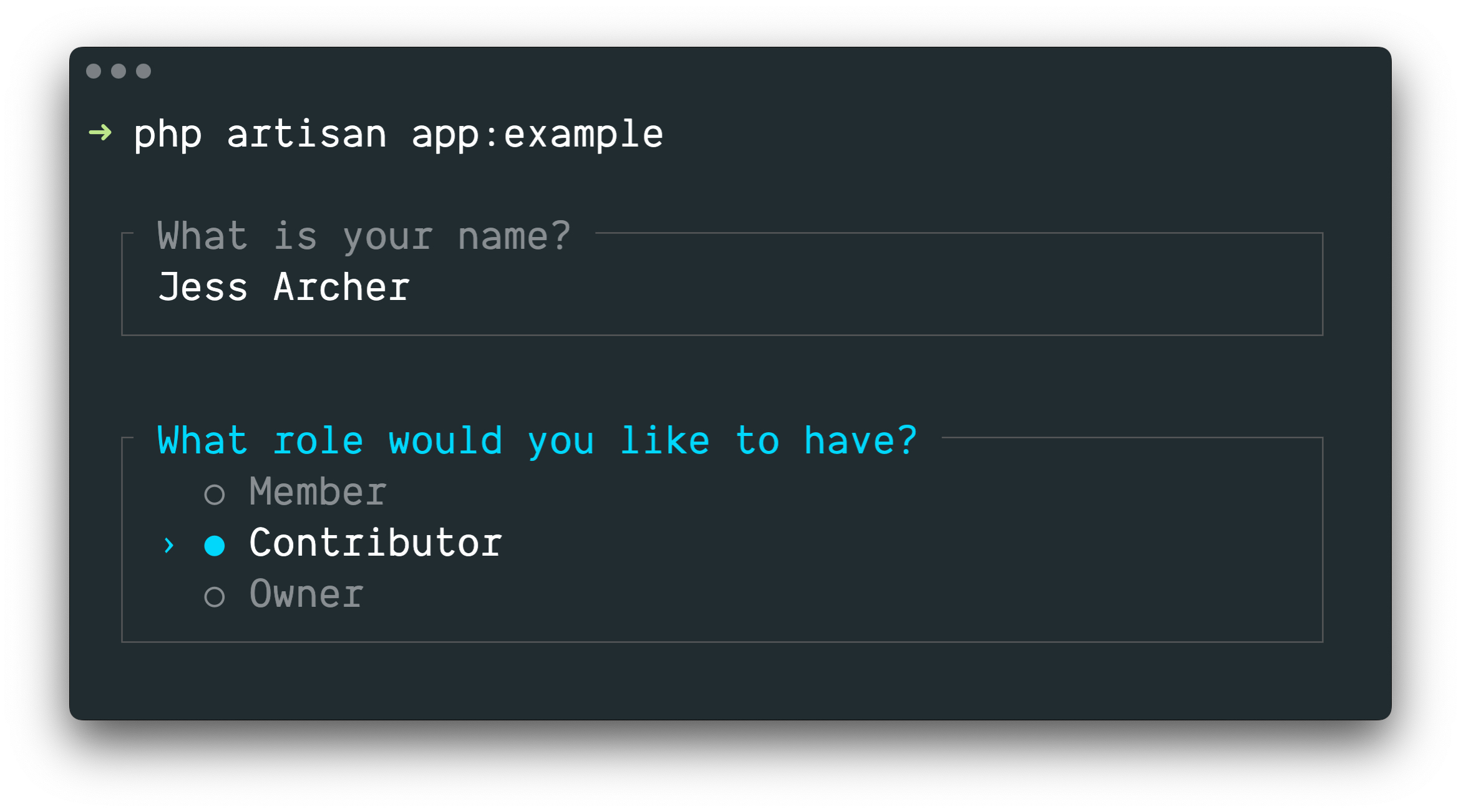
Laravel Prompts는 Artisan 콘솔 명령어에서 사용자 입력을 받을 때 매우 적합하지만, 어떤 명령줄 PHP 프로젝트에서도 사용할 수 있습니다.
Laravel Prompts는 macOS, Linux, 그리고 WSL을 사용하는 Windows를 지원합니다. 자세한 내용은 지원되지 않는 환경과 대체 동작에 대한 문서를 참고하십시오.
설치 (Installation)
Laravel Prompts는 최신 Laravel 릴리스에 이미 포함되어 있습니다.
다른 PHP 프로젝트에서도 Composer 패키지 매니저를 사용하여 Laravel Prompts를 설치할 수 있습니다.
composer require laravel/prompts
사용 가능한 프롬프트 (Available Prompts)
텍스트
text 함수는 주어진 질문을 사용자에게 표시하고, 입력을 받은 뒤 그 값을 반환합니다.
use function Laravel\Prompts\text;

$name = text('What is your name?');
플레이스홀더 텍스트, 기본값, 안내용 힌트도 함께 지정할 수 있습니다.
$name = text(
    label: 'What is your name?',
    placeholder: 'E.g. Taylor Otwell',
    default: $user?->name,
    hint: 'This will be displayed on your profile.'
);
필수 값
값을 반드시 입력해야 한다면 required 인수를 전달할 수 있습니다.
$name = text(
    label: 'What is your name?',
    required: true
);
유효성 검증 메시지를 직접 지정하고 싶다면 문자열을 전달할 수도 있습니다.
$name = text(
    label: 'What is your name?',
    required: 'Your name is required.'
);
추가 유효성 검증
마지막으로 추가 유효성 검증 로직을 수행하고 싶다면 validate 인수에 클로저를 전달할 수 있습니다.
$name = text(
    label: 'What is your name?',
    validate: fn (string $value) => match (true) {
        strlen($value) < 3 => 'The name must be at least 3 characters.',
        strlen($value) > 255 => 'The name must not exceed 255 characters.',
        default => null
    }
);
이 클로저는 입력된 값을 전달받으며, 오류 메시지를 반환하거나 유효성 검증을 통과한 경우 null을 반환할 수 있습니다.
또는 Laravel의 validator를 활용할 수도 있습니다. 이를 위해 validate 인수에 속성 이름과 원하는 유효성 검증 규칙이 포함된 배열을 전달하십시오.
$name = text(
    label: 'What is your name?',
    validate: ['name' => 'required|max:255|unique:users']
);
텍스트 영역
textarea 함수는 주어진 질문을 사용자에게 표시하고, 여러 줄을 입력할 수 있는 텍스트 영역으로 입력을 받은 뒤 그 값을 반환합니다.
use function Laravel\Prompts\textarea;

$story = textarea('Tell me a story.');
플레이스홀더 텍스트, 기본값, 안내용 힌트도 함께 지정할 수 있습니다.
$story = textarea(
    label: 'Tell me a story.',
    placeholder: 'This is a story about...',
    hint: 'This will be displayed on your profile.'
);
필수 값
값을 반드시 입력해야 한다면 required 인수를 전달할 수 있습니다.
$story = textarea(
    label: 'Tell me a story.',
    required: true
);
유효성 검증 메시지를 직접 지정하고 싶다면 문자열을 전달할 수도 있습니다.
$story = textarea(
    label: 'Tell me a story.',
    required: 'A story is required.'
);
추가 유효성 검증
마지막으로 추가 유효성 검증 로직을 수행하고 싶다면 validate 인수에 클로저를 전달할 수 있습니다.
$story = textarea(
    label: 'Tell me a story.',
    validate: fn (string $value) => match (true) {
        strlen($value) < 250 => 'The story must be at least 250 characters.',
        strlen($value) > 10000 => 'The story must not exceed 10,000 characters.',
        default => null
    }
);
이 클로저는 입력된 값을 전달받으며, 오류 메시지를 반환하거나 유효성 검증을 통과한 경우 null을 반환할 수 있습니다.
또는 Laravel의 validator를 활용할 수도 있습니다. 이를 위해 validate 인수에 속성 이름과 원하는 유효성 검증 규칙이 포함된 배열을 전달하십시오.
$story = textarea(
    label: 'Tell me a story.',
    validate: ['story' => 'required|max:10000']
);
숫자
number 함수는 주어진 질문을 사용자에게 표시하고, 숫자 입력을 받은 뒤 그 값을 반환합니다. number 함수에서는 사용자가 위쪽 및 아래쪽 화살표 키를 사용하여 숫자를 조정할 수 있습니다.
use function Laravel\Prompts\number;

$number = number('How many copies would you like?');
플레이스홀더 텍스트, 기본값, 안내용 힌트도 함께 지정할 수 있습니다.
$name = number(
    label: 'How many copies would you like?',
    placeholder: '5',
    default: 1,
    hint: 'This will be determine how many copies to create.'
);
필수 값
값을 반드시 입력해야 한다면 required 인수를 전달할 수 있습니다.
$copies = number(
    label: 'How many copies would you like?',
    required: true
);
유효성 검증 메시지를 직접 지정하고 싶다면 문자열을 전달할 수도 있습니다.
$copies = number(
    label: 'How many copies would you like?',
    required: 'A number of copies is required.'
);
추가 유효성 검증
마지막으로 추가 유효성 검증 로직을 수행하고 싶다면 validate 인수에 클로저를 전달할 수 있습니다.
$copies = number(
    label: 'How many copies would you like?',
    validate: fn (?int $value) => match (true) {
        $value < 1 => 'At least one copy is required.',
        $value > 100 => 'You may not create more than 100 copies.',
        default => null
    }
);
이 클로저는 입력된 값을 전달받으며, 오류 메시지를 반환하거나 유효성 검증을 통과한 경우 null을 반환할 수 있습니다.
또는 Laravel의 validator를 활용할 수도 있습니다. 이를 위해 validate 인수에 속성 이름과 원하는 유효성 검증 규칙이 포함된 배열을 전달하십시오.
$copies = number(
    label: 'How many copies would you like?',
    validate: ['copies' => 'required|integer|min:1|max:100']
);
비밀번호
password 함수는 text 함수와 비슷하지만, 사용자가 콘솔에 입력하는 동안 입력값이 가려집니다. 비밀번호처럼 민감한 정보를 요청할 때 유용합니다.
use function Laravel\Prompts\password;

$password = password('What is your password?');
플레이스홀더 텍스트와 안내용 힌트도 함께 지정할 수 있습니다.
$password = password(
    label: 'What is your password?',
    placeholder: 'password',
    hint: 'Minimum 8 characters.'
);
필수 값
값을 반드시 입력해야 한다면 required 인수를 전달할 수 있습니다.
$password = password(
    label: 'What is your password?',
    required: true
);
유효성 검증 메시지를 직접 지정하고 싶다면 문자열을 전달할 수도 있습니다.
$password = password(
    label: 'What is your password?',
    required: 'The password is required.'
);
추가 유효성 검증
마지막으로 추가 유효성 검증 로직을 수행하고 싶다면 validate 인수에 클로저를 전달할 수 있습니다.
$password = password(
    label: 'What is your password?',
    validate: fn (string $value) => match (true) {
        strlen($value) < 8 => 'The password must be at least 8 characters.',
        default => null
    }
);
이 클로저는 입력된 값을 전달받으며, 오류 메시지를 반환하거나 유효성 검증을 통과한 경우 null을 반환할 수 있습니다.
또는 Laravel의 validator를 활용할 수도 있습니다. 이를 위해 validate 인수에 속성 이름과 원하는 유효성 검증 규칙이 포함된 배열을 전달하십시오.
$password = password(
    label: 'What is your password?',
    validate: ['password' => 'min:8']
);
확인
사용자에게 "yes or no" 확인을 요청해야 한다면 confirm 함수를 사용할 수 있습니다. 사용자는 화살표 키를 사용하거나 y 또는 n을 눌러 응답을 선택할 수 있습니다. 이 함수는 true 또는 false를 반환합니다.
use function Laravel\Prompts\confirm;

$confirmed = confirm('Do you accept the terms?');
기본값, "Yes"와 "No" 라벨의 사용자 지정 문구, 안내용 힌트도 함께 지정할 수 있습니다.
$confirmed = confirm(
    label: 'Do you accept the terms?',
    default: false,
    yes: 'I accept',
    no: 'I decline',
    hint: 'The terms must be accepted to continue.'
);
"Yes" 선택 요구하기
필요한 경우 required 인수를 전달하여 사용자가 반드시 "Yes"를 선택하도록 요구할 수 있습니다.
$confirmed = confirm(
    label: 'Do you accept the terms?',
    required: true
);
유효성 검증 메시지를 직접 지정하고 싶다면 문자열을 전달할 수도 있습니다.
$confirmed = confirm(
    label: 'Do you accept the terms?',
    required: 'You must accept the terms to continue.'
);
선택
사용자가 미리 정의된 선택지 중 하나를 선택해야 한다면 select 함수를 사용할 수 있습니다.
use function Laravel\Prompts\select;

$role = select(
    label: 'What role should the user have?',
    options: ['Member', 'Contributor', 'Owner']
);
기본 선택지와 안내용 힌트도 지정할 수 있습니다.
$role = select(
    label: 'What role should the user have?',
    options: ['Member', 'Contributor', 'Owner'],
    default: 'Owner',
    hint: 'The role may be changed at any time.'
);
options 인수에 연관 배열을 전달하여 선택된 값 대신 선택된 키가 반환되도록 할 수도 있습니다.
$role = select(
    label: 'What role should the user have?',
    options: [
        'member' => 'Member',
        'contributor' => 'Contributor',
        'owner' => 'Owner',
    ],
    default: 'owner'
);
목록이 스크롤되기 전까지 최대 다섯 개의 옵션이 표시됩니다. scroll 인수를 전달하여 이 값을 사용자 지정할 수 있습니다.
$role = select(
    label: 'Which category would you like to assign?',
    options: Category::pluck('name', 'id'),
    scroll: 10
);
보조 정보
info 인수는 현재 강조 표시된 옵션에 대한 추가 정보를 표시하는 데 사용할 수 있습니다. 클로저를 제공하면 현재 강조 표시된 옵션의 값을 전달받으며, 문자열 또는 null을 반환해야 합니다.
$role = select(
    label: 'What role should the user have?',
    options: [
        'member' => 'Member',
        'contributor' => 'Contributor',
        'owner' => 'Owner',
    ],
    info: fn (string $value) => match ($value) {
        'member' => 'Can view and comment.',
        'contributor' => 'Can view, comment, and edit.',
        'owner' => 'Full access to all resources.',
        default => null,
    }
);
정보가 강조 표시된 옵션에 따라 달라지지 않는다면 info 인수에 정적 문자열을 전달할 수도 있습니다.
$role = select(
    label: 'What role should the user have?',
    options: ['Member', 'Contributor', 'Owner'],
    info: 'The role may be changed at any time.'
);
추가 유효성 검증
다른 프롬프트 함수와 달리 select 함수는 required 인수를 받지 않습니다. 아무것도 선택하지 않는 것이 불가능하기 때문입니다. 하지만 옵션을 보여 주되 선택되지 못하게 해야 한다면 validate 인수에 클로저를 전달할 수 있습니다.
$role = select(
    label: 'What role should the user have?',
    options: [
        'member' => 'Member',
        'contributor' => 'Contributor',
        'owner' => 'Owner',
    ],
    validate: fn (string $value) =>
        $value === 'owner' && User::where('role', 'owner')->exists()
            ? 'An owner already exists.'
            : null
);
options 인수가 연관 배열이면 클로저는 선택된 키를 전달받고, 그렇지 않으면 선택된 값을 전달받습니다. 클로저는 오류 메시지를 반환하거나, 유효성 검증이 통과하면 null을 반환할 수 있습니다.
다중 선택
사용자가 여러 옵션을 선택할 수 있어야 한다면 multiselect 함수를 사용할 수 있습니다.
use function Laravel\Prompts\multiselect;

$permissions = multiselect(
    label: 'What permissions should be assigned?',
    options: ['Read', 'Create', 'Update', 'Delete']
);
기본 선택값과 안내 힌트를 지정할 수도 있습니다.
use function Laravel\Prompts\multiselect;

$permissions = multiselect(
    label: 'What permissions should be assigned?',
    options: ['Read', 'Create', 'Update', 'Delete'],
    default: ['Read', 'Create'],
    hint: 'Permissions may be updated at any time.'
);
options 인수에 연관 배열을 전달하여 선택된 옵션의 값 대신 키가 반환되도록 할 수도 있습니다.
$permissions = multiselect(
    label: 'What permissions should be assigned?',
    options: [
        'read' => 'Read',
        'create' => 'Create',
        'update' => 'Update',
        'delete' => 'Delete',
    ],
    default: ['read', 'create']
);
목록이 스크롤되기 전까지 최대 다섯 개의 옵션이 표시됩니다. scroll 인수를 전달하여 이 값을 사용자 지정할 수 있습니다.
$categories = multiselect(
    label: 'What categories should be assigned?',
    options: Category::pluck('name', 'id'),
    scroll: 10
);
보조 정보
info 인수는 현재 강조 표시된 옵션에 대한 추가 정보를 표시하는 데 사용할 수 있습니다. 클로저를 제공하면 현재 강조 표시된 옵션의 값을 전달받으며, 문자열 또는 null을 반환해야 합니다.
$permissions = multiselect(
    label: 'What permissions should be assigned?',
    options: [
        'read' => 'Read',
        'create' => 'Create',
        'update' => 'Update',
        'delete' => 'Delete',
    ],
    info: fn (string $value) => match ($value) {
        'read' => 'View resources and their properties.',
        'create' => 'Create new resources.',
        'update' => 'Modify existing resources.',
        'delete' => 'Permanently remove resources.',
        default => null,
    }
);
값 필수 지정
기본적으로 사용자는 0개 이상의 옵션을 선택할 수 있습니다. 하나 이상의 옵션을 반드시 선택하도록 강제하려면 required 인수를 전달하면 됩니다.
$categories = multiselect(
    label: 'What categories should be assigned?',
    options: Category::pluck('name', 'id'),
    required: true
);
유효성 검증 메시지를 사용자 지정하려면 required 인수에 문자열을 제공할 수 있습니다.
$categories = multiselect(
    label: 'What categories should be assigned?',
    options: Category::pluck('name', 'id'),
    required: 'You must select at least one category'
);
추가 유효성 검증
옵션을 보여 주되 선택되지 못하게 해야 한다면 validate 인수에 클로저를 전달할 수 있습니다.
$permissions = multiselect(
    label: 'What permissions should the user have?',
    options: [
        'read' => 'Read',
        'create' => 'Create',
        'update' => 'Update',
        'delete' => 'Delete',
    ],
    validate: fn (array $values) => ! in_array('read', $values)
        ? 'All users require the read permission.'
        : null
);
options 인수가 연관 배열이면 클로저는 선택된 키들을 전달받고, 그렇지 않으면 선택된 값들을 전달받습니다. 클로저는 오류 메시지를 반환하거나, 유효성 검증이 통과하면 null을 반환할 수 있습니다.
제안
suggest 함수는 가능한 선택지에 대한 자동 완성을 제공하는 데 사용할 수 있습니다. 사용자는 자동 완성 힌트와 관계없이 어떤 답변이든 입력할 수 있습니다.
use function Laravel\Prompts\suggest;

$name = suggest('What is your name?', ['Taylor', 'Dayle']);
또는 suggest 함수의 두 번째 인수로 클로저를 전달할 수 있습니다. 클로저는 사용자가 입력 문자를 입력할 때마다 호출됩니다. 클로저는 지금까지의 사용자 입력이 담긴 문자열 매개변수를 받아야 하며, 자동 완성 옵션 배열을 반환해야 합니다.
$name = suggest(
    label: 'What is your name?',
    options: fn ($value) => collect(['Taylor', 'Dayle'])
        ->filter(fn ($name) => Str::contains($name, $value, ignoreCase: true))
)
플레이스홀더 텍스트, 기본값, 안내 힌트를 함께 포함할 수도 있습니다.
$name = suggest(
    label: 'What is your name?',
    options: ['Taylor', 'Dayle'],
    placeholder: 'E.g. Taylor',
    default: $user?->name,
    hint: 'This will be displayed on your profile.'
);
보조 정보
info 인수는 현재 강조 표시된 옵션에 대한 추가 정보를 표시하는 데 사용할 수 있습니다. 클로저를 제공하면 현재 강조 표시된 옵션의 값을 전달받으며, 문자열 또는 null을 반환해야 합니다.
$name = suggest(
    label: 'What is your name?',
    options: ['Taylor', 'Dayle'],
    info: fn (string $value) => match ($value) {
        'Taylor' => 'Administrator',
        'Dayle' => 'Contributor',
        default => null,
    }
);
필수 값
값을 반드시 입력받아야 한다면 required 인수를 전달할 수 있습니다.
$name = suggest(
    label: 'What is your name?',
    options: ['Taylor', 'Dayle'],
    required: true
);
유효성 검증 메시지를 사용자 지정하려면 문자열을 전달할 수도 있습니다.
$name = suggest(
    label: 'What is your name?',
    options: ['Taylor', 'Dayle'],
    required: 'Your name is required.'
);
추가 유효성 검증
마지막으로, 추가 유효성 검증 로직을 수행하려면 validate 인수에 클로저를 전달할 수 있습니다.
$name = suggest(
    label: 'What is your name?',
    options: ['Taylor', 'Dayle'],
    validate: fn (string $value) => match (true) {
        strlen($value) < 3 => 'The name must be at least 3 characters.',
        strlen($value) > 255 => 'The name must not exceed 255 characters.',
        default => null
    }
);
클로저는 입력된 값을 전달받으며, 오류 메시지를 반환하거나 유효성 검증이 통과하면 null을 반환할 수 있습니다.
또는 Laravel의 validator 기능을 활용할 수도 있습니다. 이를 사용하려면 속성 이름과 원하는 유효성 검증 규칙을 담은 배열을 validate 인수에 제공하세요.
$name = suggest(
    label: 'What is your name?',
    options: ['Taylor', 'Dayle'],
    validate: ['name' => 'required|min:3|max:255']
);
검색
사용자가 선택해야 할 옵션이 많다면 search 함수를 사용하여 사용자가 검색어를 입력해 결과를 필터링한 뒤, 화살표 키로 옵션을 선택할 수 있게 할 수 있습니다.
use function Laravel\Prompts\search;

$id = search(
    label: 'Search for the user that should receive the mail',
    options: fn (string $value) => strlen($value) > 0
        ? User::whereLike('name', "%{$value}%")->pluck('name', 'id')->all()
        : []
);
클로저는 사용자가 지금까지 입력한 텍스트를 전달받으며, 옵션 배열을 반환해야 합니다. 연관 배열을 반환하면 선택된 옵션의 키가 반환되고, 그렇지 않으면 값이 반환됩니다.
값을 반환하려는 의도로 배열을 필터링할 때는 배열이 연관 배열이 되지 않도록 array_values 함수 또는 values Collection 메서드를 사용해야 합니다.
$names = collect(['Taylor', 'Abigail']);

$selected = search(
    label: 'Search for the user that should receive the mail',
    options: fn (string $value) => $names
        ->filter(fn ($name) => Str::contains($name, $value, ignoreCase: true))
        ->values()
        ->all(),
);
플레이스홀더 텍스트와 안내 힌트를 함께 포함할 수도 있습니다.
$id = search(
    label: 'Search for the user that should receive the mail',
    placeholder: 'E.g. Taylor Otwell',
    options: fn (string $value) => strlen($value) > 0
        ? User::whereLike('name', "%{$value}%")->pluck('name', 'id')->all()
        : [],
    hint: 'The user will receive an email immediately.'
);
목록이 스크롤되기 전까지 최대 다섯 개의 옵션이 표시됩니다. scroll 인수를 전달하여 이 값을 사용자 지정할 수 있습니다.
$id = search(
    label: 'Search for the user that should receive the mail',
    options: fn (string $value) => strlen($value) > 0
        ? User::whereLike('name', "%{$value}%")->pluck('name', 'id')->all()
        : [],
    scroll: 10
);
보조 정보
info 인수는 현재 강조 표시된 옵션에 대한 추가 정보를 표시하는 데 사용할 수 있습니다. 클로저를 제공하면 현재 강조 표시된 옵션의 값을 전달받으며, 문자열 또는 null을 반환해야 합니다.
$id = search(
    label: 'Search for the user that should receive the mail',
    options: fn (string $value) => strlen($value) > 0
        ? User::whereLike('name', "%{$value}%")->pluck('name', 'id')->all()
        : [],
    info: fn (int $userId) => User::find($userId)?->email
);
추가 유효성 검증
추가 유효성 검증 로직을 수행하려면 validate 인수에 클로저를 전달할 수 있습니다.
$id = search(
    label: 'Search for the user that should receive the mail',
    options: fn (string $value) => strlen($value) > 0
        ? User::whereLike('name', "%{$value}%")->pluck('name', 'id')->all()
        : [],
    validate: function (int|string $value) {
        $user = User::findOrFail($value);

        if ($user->opted_out) {
            return 'This user has opted-out of receiving mail.';
        }
    }
);
options 클로저가 연관 배열을 반환하면 클로저는 선택된 키를 전달받고, 그렇지 않으면 선택된 값을 전달받습니다. 클로저는 오류 메시지를 반환하거나, 유효성 검증이 통과하면 null을 반환할 수 있습니다.
다중 검색
검색 가능한 옵션이 많고 사용자가 여러 항목을 선택할 수 있어야 한다면 multisearch 함수를 사용하여 사용자가 검색어를 입력해 결과를 필터링한 뒤, 화살표 키와 스페이스바로 옵션을 선택할 수 있게 할 수 있습니다.
use function Laravel\Prompts\multisearch;

$ids = multisearch(
    'Search for the users that should receive the mail',
    fn (string $value) => strlen($value) > 0
        ? User::whereLike('name', "%{$value}%")->pluck('name', 'id')->all()
        : []
);
클로저는 사용자가 지금까지 입력한 텍스트를 전달받으며, 옵션 배열을 반환해야 합니다. 연관 배열을 반환하면 선택된 옵션의 키가 반환됩니다. 그렇지 않으면 선택된 옵션의 값이 반환됩니다.
값을 반환하려는 배열을 필터링할 때는 배열이 연관 배열로 바뀌지 않도록 array_values 함수나 values Collection 메서드를 사용해야 합니다.
$names = collect(['Taylor', 'Abigail']);

$selected = multisearch(
    label: 'Search for the users that should receive the mail',
    options: fn (string $value) => $names
        ->filter(fn ($name) => Str::contains($name, $value, ignoreCase: true))
        ->values()
        ->all(),
);
플레이스홀더 텍스트와 안내 힌트를 함께 포함할 수도 있습니다.
$ids = multisearch(
    label: 'Search for the users that should receive the mail',
    placeholder: 'E.g. Taylor Otwell',
    options: fn (string $value) => strlen($value) > 0
        ? User::whereLike('name', "%{$value}%")->pluck('name', 'id')->all()
        : [],
    hint: 'The user will receive an email immediately.'
);
목록이 스크롤되기 전까지 최대 다섯 개의 옵션이 표시됩니다. scroll 인수를 제공하여 이 값을 사용자 정의할 수 있습니다.
$ids = multisearch(
    label: 'Search for the users that should receive the mail',
    options: fn (string $value) => strlen($value) > 0
        ? User::whereLike('name', "%{$value}%")->pluck('name', 'id')->all()
        : [],
    scroll: 10
);
보조 정보
info 인수는 현재 강조된 옵션에 대한 추가 정보를 표시하는 데 사용할 수 있습니다. 클로저를 제공하면 현재 강조된 옵션의 값을 전달받으며, 문자열 또는 null을 반환해야 합니다.
$ids = multisearch(
    label: 'Search for the users that should receive the mail',
    options: fn (string $value) => strlen($value) > 0
        ? User::whereLike('name', "%{$value}%")->pluck('name', 'id')->all()
        : [],
    info: fn (int $userId) => User::find($userId)?->email
);
값 필수 지정
기본적으로 사용자는 옵션을 하나도 선택하지 않거나 여러 개 선택할 수 있습니다. 하나 이상의 옵션을 반드시 선택하도록 하려면 required 인수를 전달하면 됩니다.
$ids = multisearch(
    label: 'Search for the users that should receive the mail',
    options: fn (string $value) => strlen($value) > 0
        ? User::whereLike('name', "%{$value}%")->pluck('name', 'id')->all()
        : [],
    required: true
);
유효성 검증 메시지를 사용자 정의하려면 required 인수에 문자열을 제공할 수도 있습니다.
$ids = multisearch(
    label: 'Search for the users that should receive the mail',
    options: fn (string $value) => strlen($value) > 0
        ? User::whereLike('name', "%{$value}%")->pluck('name', 'id')->all()
        : [],
    required: 'You must select at least one user.'
);
추가 유효성 검증
추가 유효성 검증 로직을 수행하려면 validate 인수에 클로저를 전달할 수 있습니다.
$ids = multisearch(
    label: 'Search for the users that should receive the mail',
    options: fn (string $value) => strlen($value) > 0
        ? User::whereLike('name', "%{$value}%")->pluck('name', 'id')->all()
        : [],
    validate: function (array $values) {
        $optedOut = User::whereLike('name', '%a%')->findMany($values);

        if ($optedOut->isNotEmpty()) {
            return $optedOut->pluck('name')->join(', ', ', and ').' have opted out.';
        }
    }
);
options 클로저가 연관 배열을 반환하면 이 클로저는 선택된 키를 전달받습니다. 그렇지 않으면 선택된 값을 전달받습니다. 클로저는 오류 메시지를 반환하거나, 유효성 검증을 통과한 경우 null을 반환할 수 있습니다.
일시 중지
pause 함수는 사용자에게 안내 텍스트를 표시하고, 사용자가 Enter / Return 키를 눌러 계속 진행할 의사가 있음을 확인할 때까지 기다리는 데 사용할 수 있습니다.
use function Laravel\Prompts\pause;

pause('Press ENTER to continue.');
자동 완성
autocomplete 함수는 가능한 선택지에 대해 인라인 자동 완성을 제공하는 데 사용할 수 있습니다. 사용자가 입력하면 입력값과 일치하는 제안이 고스트 텍스트로 표시되며, Tab 또는 오른쪽 화살표 키를 눌러 적용할 수 있습니다.
use function Laravel\Prompts\autocomplete;

$name = autocomplete(
    label: 'What is your name?',
    options: ['Taylor', 'Dayle', 'Jess', 'Nuno', 'Tim']
);
플레이스홀더 텍스트, 기본값, 안내 힌트를 함께 포함할 수도 있습니다.
$name = autocomplete(
    label: 'What is your name?',
    options: ['Taylor', 'Dayle', 'Jess', 'Nuno', 'Tim'],
    placeholder: 'E.g. Taylor',
    default: $user?->name,
    hint: 'Use tab to accept, up/down to cycle.'
);
동적 옵션
사용자의 입력을 기반으로 옵션을 동적으로 생성하기 위해 클로저를 전달할 수도 있습니다. 이 클로저는 사용자가 문자를 입력할 때마다 호출되며, 자동 완성에 사용할 옵션 배열을 반환해야 합니다.
$file = autocomplete(
    label: 'Which file?',
    options: fn (string $value) => collect($files)
        ->filter(fn ($file) => str_starts_with(strtolower($file), strtolower($value)))
        ->values()
        ->all(),
);
필수 값
값을 반드시 입력해야 한다면 required 인수를 전달할 수 있습니다.
$name = autocomplete(
    label: 'What is your name?',
    options: ['Taylor', 'Dayle', 'Jess', 'Nuno', 'Tim'],
    required: true
);
유효성 검증 메시지를 사용자 정의하려면 문자열을 전달할 수도 있습니다.
$name = autocomplete(
    label: 'What is your name?',
    options: ['Taylor', 'Dayle', 'Jess', 'Nuno', 'Tim'],
    required: 'Your name is required.'
);
추가 유효성 검증
마지막으로, 추가 유효성 검증 로직을 수행하려면 validate 인수에 클로저를 전달할 수 있습니다.
$name = autocomplete(
    label: 'What is your name?',
    options: ['Taylor', 'Dayle', 'Jess', 'Nuno', 'Tim'],
    validate: fn (string $value) => match (true) {
        strlen($value) < 3 => 'The name must be at least 3 characters.',
        strlen($value) > 255 => 'The name must not exceed 255 characters.',
        default => null
    }
);
클로저는 입력된 값을 전달받으며, 오류 메시지를 반환하거나 유효성 검증을 통과한 경우 null을 반환할 수 있습니다.
유효성 검증 전 입력 변환 (Transforming Input Before Validation)
때로는 유효성 검증이 수행되기 전에 프롬프트 입력값을 변환하고 싶을 수 있습니다. 예를 들어, 제공된 문자열에서 공백을 제거하고 싶을 수 있습니다. 이를 위해 여러 프롬프트 함수는 클로저를 받는 transform 인수를 제공합니다.
$name = text(
    label: 'What is your name?',
    transform: fn (string $value) => trim($value),
    validate: fn (string $value) => match (true) {
        strlen($value) < 3 => 'The name must be at least 3 characters.',
        strlen($value) > 255 => 'The name must not exceed 255 characters.',
        default => null
    }
);
폼 (Forms)
추가 작업을 수행하기 전에 정보를 수집하기 위해 여러 프롬프트를 순서대로 표시해야 하는 경우가 많습니다. form 함수를 사용하면 사용자가 완료할 프롬프트 묶음을 만들 수 있습니다.
use function Laravel\Prompts\form;

$responses = form()
    ->text('What is your name?', required: true)
    ->password('What is your password?', validate: ['password' => 'min:8'])
    ->confirm('Do you accept the terms?')
    ->submit();
submit 메서드는 폼의 프롬프트에서 받은 모든 응답을 숫자 인덱스 배열로 반환합니다. 하지만 name 인수를 통해 각 프롬프트에 이름을 지정할 수 있습니다. 이름이 제공되면 해당 이름으로 프롬프트의 응답에 접근할 수 있습니다.
use App\Models\User;
use function Laravel\Prompts\form;

$responses = form()
    ->text('What is your name?', required: true, name: 'name')
    ->password(
        label: 'What is your password?',
        validate: ['password' => 'min:8'],
        name: 'password'
    )
    ->confirm('Do you accept the terms?')
    ->submit();

User::create([
    'name' => $responses['name'],
    'password' => $responses['password'],
]);
form 함수를 사용할 때의 주요 장점은 사용자가 CTRL + U를 사용하여 폼의 이전 프롬프트로 돌아갈 수 있다는 점입니다. 이를 통해 사용자는 전체 폼을 취소하고 다시 시작할 필요 없이 실수를 수정하거나 선택을 변경할 수 있습니다.
폼 안의 프롬프트를 더 세밀하게 제어해야 한다면, 프롬프트 함수 중 하나를 직접 호출하는 대신 add 메서드를 호출할 수 있습니다. add 메서드에는 사용자가 이전에 제공한 모든 응답이 전달됩니다.
use function Laravel\Prompts\form;
use function Laravel\Prompts\outro;
use function Laravel\Prompts\text;

$responses = form()
    ->text('What is your name?', required: true, name: 'name')
    ->add(function ($responses) {
        return text("How old are you, {$responses['name']}?");
    }, name: 'age')
    ->submit();

outro("Your name is {$responses['name']} and you are {$responses['age']} years old.");
안내 메시지 (Informational Messages)
note, info, warning, error, alert 함수는 안내 메시지를 표시하는 데 사용할 수 있습니다.
use function Laravel\Prompts\info;

info('Package installed successfully.');
테이블 (Tables)
table 함수를 사용하면 여러 행과 컬럼으로 이루어진 데이터를 쉽게 표시할 수 있습니다. 컬럼 이름과 테이블 데이터를 제공하기만 하면 됩니다.
use function Laravel\Prompts\table;

table(
    headers: ['Name', 'Email'],
    rows: User::all(['name', 'email'])->toArray()
);
스핀 (Spin)
spin 함수는 지정된 콜백을 실행하는 동안 선택적 메시지와 함께 스피너를 표시합니다. 진행 중인 프로세스를 나타내는 역할을 하며, 완료되면 콜백의 결과를 반환합니다.
use function Laravel\Prompts\spin;

$response = spin(
    callback: fn () => Http::get('http://example.com'),
    message: 'Fetching response...'
);
spin함수는 스피너 애니메이션을 표시하기 위해 PCNTL PHP 확장 기능이 필요합니다. 이 확장 기능을 사용할 수 없는 경우에는 스피너의 정적 버전이 대신 표시됩니다.
진행률 표시줄 (Progress Bars)
오래 실행되는 작업에서는 작업이 얼마나 완료되었는지 사용자에게 알려주는 진행률 표시줄을 보여주는 것이 도움이 될 수 있습니다. progress 함수를 사용하면 Laravel은 진행률 표시줄을 표시하고, 주어진 iterable 값의 각 반복마다 진행률을 증가시킵니다.
use function Laravel\Prompts\progress;

$users = progress(
    label: 'Updating users',
    steps: User::all(),
    callback: fn ($user) => $this->performTask($user)
);
progress 함수는 map 함수처럼 동작하며, 콜백의 각 반복에서 반환된 값을 담은 배열을 반환합니다.
콜백은 Laravel\Prompts\Progress 인스턴스를 함께 받을 수도 있습니다. 이를 통해 각 반복마다 라벨과 힌트를 수정할 수 있습니다.
$users = progress(
    label: 'Updating users',
    steps: User::all(),
    callback: function ($user, $progress) {
        $progress
            ->label("Updating {$user->name}")
            ->hint("Created on {$user->created_at}");

        return $this->performTask($user);
    },
    hint: 'This may take some time.'
);
때로는 진행률 표시줄을 어떻게 증가시킬지 더 수동으로 제어해야 할 수 있습니다. 먼저 프로세스가 반복할 총 단계 수를 정의합니다. 그런 다음 각 항목을 처리한 뒤 advance 메서드를 통해 진행률 표시줄을 증가시킵니다.
$progress = progress(label: 'Updating users', steps: 10);

$users = User::all();

$progress->start();

foreach ($users as $user) {
    $this->performTask($user);

    $progress->advance();
}

$progress->finish();
작업 (Task)
task 함수는 주어진 콜백이 실행되는 동안 스피너와 스크롤되는 실시간 출력 영역을 포함한 라벨이 있는 작업을 표시합니다. 의존성 설치나 배포 스크립트처럼 오래 실행되는 프로세스를 감싸기에 적합하며, 현재 어떤 일이 일어나고 있는지 실시간으로 확인할 수 있게 해줍니다.
use function Laravel\Prompts\task;

task(
    label: 'Installing dependencies',
    callback: function ($logger) {
        // Long-running process...
    }
);
콜백은 Logger 인스턴스를 전달받습니다. 이를 사용하여 작업의 출력 영역에 로그 라인, 상태 메시지, 스트리밍 텍스트를 표시할 수 있습니다.
task함수는 스피너 애니메이션을 표시하기 위해 PCNTL PHP 확장 기능이 필요합니다. 이 확장 기능을 사용할 수 없는 경우에는 작업의 정적 버전이 대신 표시됩니다.
로그 라인
line 메서드는 작업의 스크롤되는 출력 영역에 로그 한 줄을 씁니다.
task(
    label: 'Installing dependencies',
    callback: function ($logger) {
        $logger->line('Resolving packages...');
        // ...
        $logger->line('Downloading laravel/framework');
        // ...
    }
);
상태 메시지
success, warning, error 메서드를 사용하여 상태 메시지를 표시할 수 있습니다. 이 메시지는 스크롤되는 로그 영역 위에 고정된 강조 메시지로 나타납니다.
task(
    label: 'Deploying application',
    callback: function ($logger) {
        $logger->line('Pulling latest changes...');
        // ...
        $logger->success('Changes pulled!');

        $logger->line('Running migrations...');
        // ...
        $logger->warning('No new migrations to run.');

        $logger->line('Clearing cache...');
        // ...
        $logger->success('Cache cleared!');
    }
);
레이블 업데이트
label 메서드를 사용하면 작업이 실행되는 동안 작업의 레이블을 업데이트할 수 있습니다.
task(
    label: 'Starting deployment...',
    callback: function ($logger) {
        $logger->label('Pulling latest changes...');
        // ...
        $logger->label('Running migrations...');
        // ...
        $logger->label('Clearing cache...');
        // ...
    }
);
하위 레이블 표시
subLabel 메서드는 작업의 기본 레이블 아래에 흐리게 표시되는 줄을 보여줍니다. 현재 진행 중인 단계처럼 일시적인 상태를 전달할 때 유용합니다. 하위 레이블을 지우려면 빈 문자열을 전달합니다.
task(
    label: 'Deploying',
    callback: function ($logger) {
        $logger->subLabel('Building assets...');
        // ...
        $logger->subLabel('Running migrations...');
        // ...
        $logger->subLabel('');
    }
);
subLabel 인수를 통해 초기 하위 레이블을 제공할 수도 있습니다.
task(
    label: 'Deploying',
    callback: function ($logger) {
        // ...
    },
    subLabel: 'Preparing...'
);
텍스트 스트리밍
AI 생성 응답처럼 출력이 점진적으로 생성되는 프로세스에서는 partial 메서드를 사용해 텍스트를 단어 단위 또는 청크 단위로 스트리밍할 수 있습니다. 스트림이 완료되면 commitPartial을 호출하여 출력을 확정합니다.
task(
    label: 'Generating response...',
    callback: function ($logger) {
        foreach ($words as $word) {
            $logger->partial($word . ' ');
        }

        $logger->commitPartial();
    }
);
출력 제한 사용자 정의
기본적으로 작업은 스크롤되는 출력을 최대 10줄까지 표시합니다. limit 인수를 통해 이를 사용자 정의할 수 있습니다.
task(
    label: 'Installing dependencies',
    callback: function ($logger) {
        // ...
    },
    limit: 20
);
요약 유지
기본적으로 작업의 출력은 콜백이 완료되면 지워집니다. 작업이 완료된 후에도 상태 메시지를 화면에 유지하려면 keepSummary 인수를 전달할 수 있습니다.
task(
    label: 'Deploying',
    callback: function ($logger) {
        $logger->success('Assets built');
        // ...
        $logger->success('Migrations complete');
    },
    keepSummary: true,
);
스트림 (Stream)
stream 함수는 터미널로 스트리밍되는 텍스트를 표시합니다. AI 생성 콘텐츠나 점진적으로 도착하는 텍스트를 표시하는 데 적합합니다.
use function Laravel\Prompts\stream;

$stream = stream();

foreach ($words as $word) {
    $stream->append($word . ' ');
    usleep(25_000); // Simulate delay between chunks...
}

$stream->close();
append 메서드는 스트림에 텍스트를 추가하고, 점진적인 페이드인 효과와 함께 렌더링합니다. 모든 콘텐츠가 스트리밍되면 close 메서드를 호출하여 출력을 확정하고 커서를 복원합니다.
터미널 제목 (Terminal Title)
title 함수는 사용자의 터미널 창 또는 탭 제목을 업데이트합니다.
use function Laravel\Prompts\title;

title('Installing Dependencies');
터미널 제목을 기본값으로 되돌리려면 빈 문자열을 전달합니다.
title('');
터미널 지우기 (Clearing the Terminal)
clear 함수는 사용자의 터미널을 지우는 데 사용할 수 있습니다.
use function Laravel\Prompts\clear;

clear();
터미널 고려 사항 (Terminal Considerations)
터미널 너비
레이블, 옵션, 유효성 검증 메시지의 길이가 사용자의 터미널 "컬럼" 수를 초과하면, 맞게 표시되도록 자동으로 잘립니다. 사용자가 더 좁은 터미널을 사용할 수 있다면 이러한 문자열의 길이를 줄이는 것을 고려하세요. 일반적으로 80자 터미널을 지원하기 위한 안전한 최대 길이는 74자입니다.
터미널 높이
scroll 인수를 받는 모든 프롬프트에서는 설정된 값이 사용자의 터미널 높이에 맞게 자동으로 줄어듭니다. 이때 유효성 검증 메시지를 위한 공간도 포함됩니다.
지원되지 않는 환경과 폴백 (Unsupported Environments and Fallbacks)
Laravel Prompts는 macOS, Linux, 그리고 WSL이 있는 Windows를 지원합니다. Windows 버전 PHP의 제한 사항 때문에, 현재 WSL 밖의 Windows에서는 Laravel Prompts를 사용할 수 없습니다.
이러한 이유로 Laravel Prompts는 Symfony Console Question Helper와 같은 대체 구현으로 폴백하는 기능을 지원합니다.
Laravel 프레임워크와 함께 Laravel Prompts를 사용할 때는 각 프롬프트의 폴백이 이미 구성되어 있으며, 지원되지 않는 환경에서 자동으로 활성화됩니다.
폴백 조건
Laravel을 사용하지 않거나 폴백 동작이 사용되는 시점을 사용자 정의해야 한다면, Prompt 클래스의 fallbackWhen 정적 메서드에 boolean 값을 전달할 수 있습니다.
use Laravel\Prompts\Prompt;

Prompt::fallbackWhen(
    ! $input->isInteractive() || windows_os() || app()->runningUnitTests()
);
폴백 동작
Laravel을 사용하지 않거나 폴백 동작을 사용자 정의해야 한다면, 각 프롬프트 클래스의 fallbackUsing 정적 메서드에 클로저를 전달할 수 있습니다.
use Laravel\Prompts\TextPrompt;
use Symfony\Component\Console\Question\Question;
use Symfony\Component\Console\Style\SymfonyStyle;

TextPrompt::fallbackUsing(function (TextPrompt $prompt) use ($input, $output) {
    $question = (new Question($prompt->label, $prompt->default ?: null))
        ->setValidator(function ($answer) use ($prompt) {
            if ($prompt->required && $answer === null) {
                throw new \RuntimeException(
                    is_string($prompt->required) ? $prompt->required : 'Required.'
                );
            }

            if ($prompt->validate) {
                $error = ($prompt->validate)($answer ?? '');

                if ($error) {
                    throw new \RuntimeException($error);
                }
            }

            return $answer;
        });

    return (new SymfonyStyle($input, $output))
        ->askQuestion($question);
});
폴백은 각 프롬프트 클래스마다 개별적으로 구성해야 합니다. 클로저는 프롬프트 클래스의 인스턴스를 받고, 해당 프롬프트에 적절한 타입을 반환해야 합니다.
테스트 (Testing)
Laravel은 명령어가 예상한 Prompt 메시지를 표시하는지 테스트할 수 있는 다양한 메서드를 제공합니다.
test('report generation', function () {
$this->artisan('report:generate')
->expectsPromptsInfo('Welcome to the application!')
->expectsPromptsWarning('This action cannot be undone')
->expectsPromptsError('Something went wrong')
->expectsPromptsAlert('Important notice!')
->expectsPromptsIntro('Starting process...')
->expectsPromptsOutro('Process completed!')
->expectsPromptsTable(
headers: ['Name', 'Email'],
rows: [
]
)
->assertExitCode(0);
});
public function test_report_generation(): void
{
$this->artisan('report:generate')
->expectsPromptsInfo('Welcome to the application!')
->expectsPromptsWarning('This action cannot be undone')
->expectsPromptsError('Something went wrong')
->expectsPromptsAlert('Important notice!')
->expectsPromptsIntro('Starting process...')
->expectsPromptsOutro('Process completed!')
->expectsPromptsTable(
headers: ['Name', 'Email'],
rows: [
]
)
->assertExitCode(0);
}